Lucien Smith’s Next Act
This feature, originally published in Justsmile Issue 7, October 2025, is being made available online to honor Lucien Smith’s life. His passing was announced on September 7, 2026.
This story appears in Justsmile Issue 7, What We Carry Forward.
Photography Anthony Lorelli
Text Connor Garel
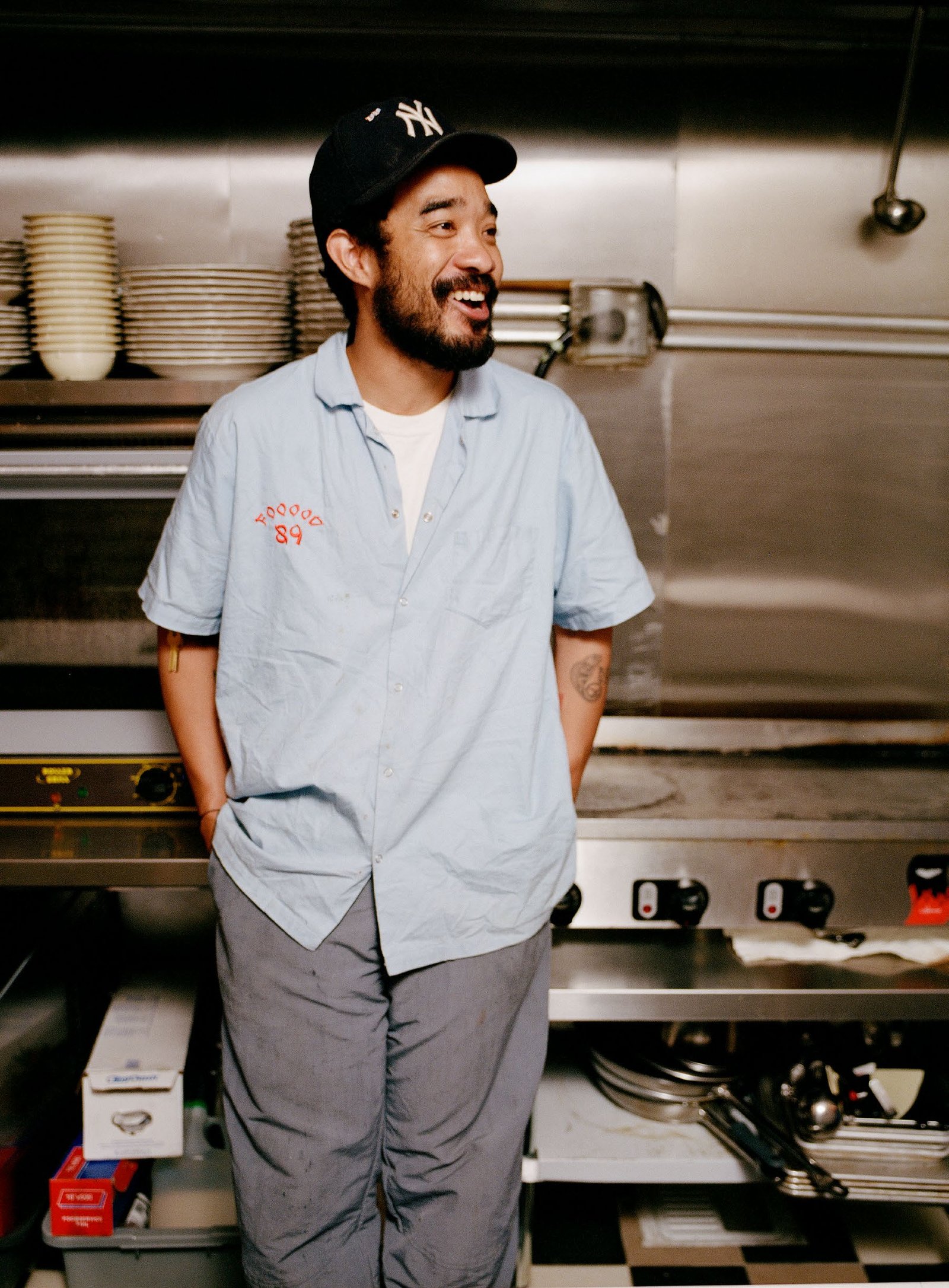
Photography Anthony Lorelli
“An art practice is so self-centered,” says the 36-year-old Lucien Smith. Eleven or 12 years out from his days as an art world wunderkind, he looks back on that violent, premature success—predicated on landscapes copied from Winnie-the-Pooh, aluminum pie trays splattered across canvases, and hundreds of abstract paintings made with pigment-filled fire extinguishers to approximate rainfall—as a sort of higher masturbation. “I think we’re sort of, like, post-art now.”
When Smith sprung up out of the Cooper Union in 2011, arrogant and hungry to prove himself, he almost immediately became the simultaneous victim and beneficiary of a rapacious art world, his works feverishly acquired by dealers and then resold at auction for hundreds of thousands of dollars. In the magazines, art critics complained about the rise of “Zombie Formalism”: a seemingly market-driven genre of painting, devoid, they said, of emotion or aesthetic innovation, that mimicked the conventions of the abstract expressionists while fetishizing the processes used to create them. But it didn’t matter that these critics didn’t like the paintings. The records that Smith hoped to break broke. The attention he’d courted arrived. Just as he’d wanted, he became a near-overnight success in the spiritual tradition of Warhol, exhibiting at blue-chip galleries, modeling for Supreme, collaborating with Virgil Abloh on screen-printed t-shirts, and throwing star-studded warehouse raves in the Bronx decorated with his hugely controversial bullet-riddled cars. Just as quickly, he found he wanted none of it.
And anyways, it wasn’t actually sustainable. Every bubble eventually bursts. His prices tanked; he partied too much; he realized he didn’t like himself, or the scores of people around him vying for fame and fortune. That harsh new light, cast upon the commercialist machinery of the downtown art scene, was equal parts dizzying and disillusioning. Smith fled to Montauk to straighten out his existential crisis, started a non-profit called Serve the People to “bring awareness to the unrefined, uncommercial,” abandoned painting as his primary focus, and tried to undo the psychic damage he’d incurred from his success.
Today, he wonders if it was all just an act, that vanished life as a shooting star climbing over the New York art world. With critic sharpness and the fear of failure—already faced—mostly behind him, Smith has settled on his latest act: restaurateur. He soft-launched FOOD in June 2025, a reanimation of the iconic, artist-run establishment founded in 1971 by dancer-photographer Carol Goodden and her then-boyfriend, the late artist Gordon Matta-Clark. The old FOOD was based in Soho, with a menu that consisted mostly of soups and gumbos; the point was to make jobs for Goodden and Matta-Clark’s friends, who were mostly artists, and to offer an airy, nourishing clubhouse to serve a still-industrial neighborhood. Smith’s FOOD attempts to preserve many of these qualities, relocating the institution to Dimes Square and tapping French chef Mathieu Canet to develop the menu.
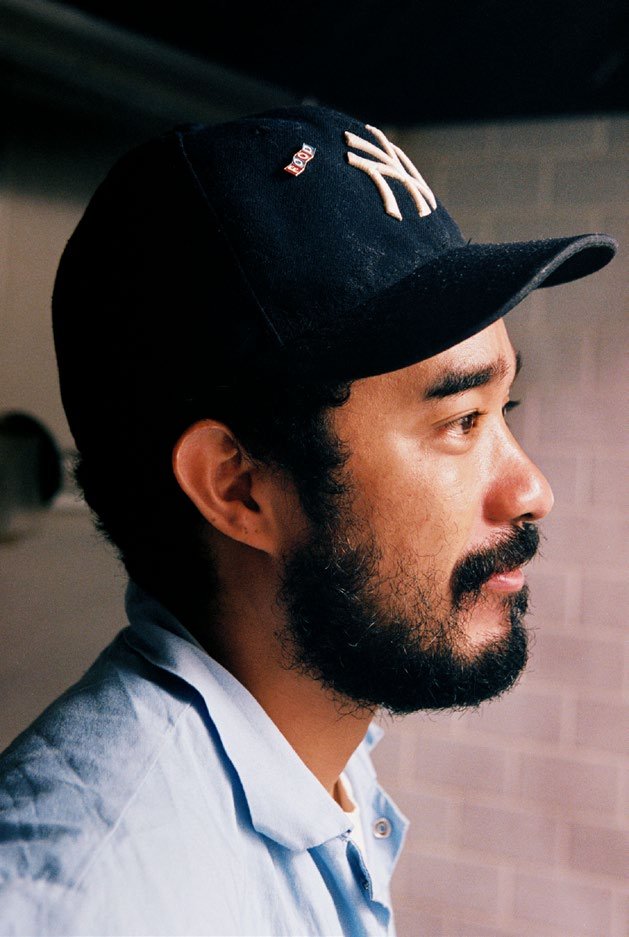
Following a breakneck career in the art world, Smith is finding grounding as he learns to run a restaurant.
I reach him over the phone at 11 a.m. on a Monday—one of the two days of the week that FOOD is closed—and can already hear him puttering around the restaurant, tossing off directions, chewing on something, pleased to be occupied by the structure of a nine-to-five.
Connor Garel: It seems to me that you’ve reverse-engineered your career. Usually, the story goes that the artist does the bartending work, the restaurant job, the toiling away in the gig economy to finance the creative work, in the hopes of eventually making a life doing that full time. But you’ve gone the opposite route.
Lucien Smith: For a while, I think I felt a little bit drained by the creative process, or having to produce art for art’s sake. It was something that was bothering me for quite a few years. And I remember seeing this skit in that movie Man on the Moon, about Andy Kaufman, played by Jim Carrey. Kaufman was this entertainer, and a method actor. There’s this part where he’s at this diner. I guess he would do that—work odd jobs as a character study, or maybe just as a way to escape the downfalls of being a comedian, and of show business. That fascinated me, this idea of being able to switch occupations.
I guess it’s an extension of my practice. An artist creates, and this is just another creation. I was becoming very bored with the very rigid format of fine art: the rectangular canvas, the materials, the museum, the need to sell an artwork or hang it on a wall. The other night, I had just gone down to the restaurant at, like, 11 p.m., for no reason other than to just check on it and tidy up. I can’t remember ever feeling that sort of responsibility or calling with art. Simple stuff like cleaning the studio or my brushes always felt like a chore. I don’t want to think that I just happened to stumble upon art early, and I was good enough at it to be successful, but what I really am is a restaurateur… That seems too far. For me to think about this as its own artwork is a little bit more satisfying, and less scary of a thought.[a]
CG: You don’t have any history of working in restaurants. But you’ve spent a lot of time being really successful at making art, and being praised for it widely. Praise can be good, but I wonder about the effects of having so much of it so soon, and how it colors an approach to starting something new so publicly.
LS: I’ve been trying to think about what this would look like 30 years ago. I think because of the internet and Instagram, everything is, in some way, open source, and I guess I had to be sort of public about it to promote it. But I don’t look at it as a career change, really. I look at it as an evolution. Looking back, I think that urge to self-edit, to want to retract, or this anxiety of being too early to bring something to the public—maybe that applies to my career in art, but not the restaurant. I was cleaning my office the other day and pulling out stuff that I had made recently or semi-recently, just feeling like the culture, at the time, was really hungry for younger artists. Maybe that situation accelerated my career for reasons it shouldn’t have. Maybe I was thrown into a spotlight before I was ready for it. It’s not that I didn’t want it, but maybe it wasn’t coming to me so naturally. It’s a very special situation. I don’t know if it had more of a positive or negative effect on my development as a person, but it’s led me to this place that I’m grateful for.
CG: Do you feel more normal?
LS: I’m definitely more confident in myself, and I have an abundance of experiences that I can look back on to help me make decisions, whereas at 19 years old, I didn’t really have any of that ammo. I was just shooting from the waist, going about life as it came. Which is one of the reasons that I tried to slow my career down: I was having to make all of these very quick decisions, some of them from a place where I had no real knowledge or experience or any mentors guiding me. My situation was rare. I’ve made so many mistakes in my career and my life that I’ve developed these calluses to help to steer myself and avoid certain pains.
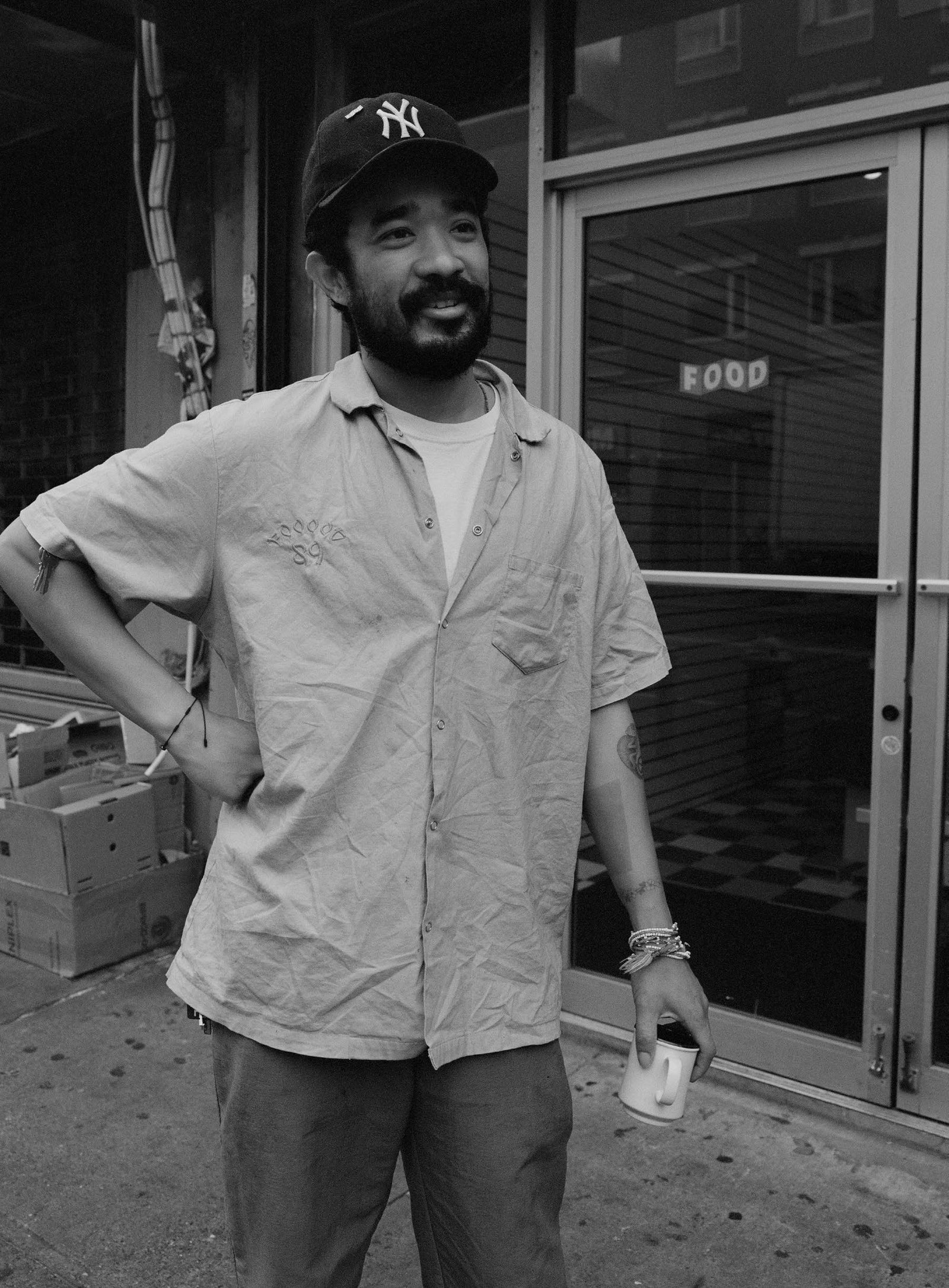
Originally based in Soho, FOOD’s second home is at 89 Canal St in Chinatown. It still retains key original features, like a set nightly menu.
CG: Let’s say the life of Lucien Smith is a film, and there’s this scene when it occurs to you that this life you have, of being this young, fresh-faced art world star, is one you don’t want anymore. What’s the crisis point?
LS: I had this real mental breakdown from, like, 23 to 25. I had to be hospitalized a few times. And it just felt like the more I kept going, the more the life that I wanted drew further away. The people in my life were just leaving. I couldn’t really get a grip on anything. I started taking medication. It just seemed like being an artist was fueling the fire somehow. So I just stopped throwing wood into the fire for a while. It’s not like anything changed overnight. I’m sort of just coming out of the post-breakdown. I think from 25 until my early 30s, [my time] was spent the way most people spend the early part of their lives, which is figuring out what the hell they want to do and who they want to be, you know?
CG: Another coming of age.
LS: I think that’s where the reverse-engineering stuff comes about. It was after my career in art that I had the time to think about what I wanted to do with my life. And this restaurant comes out of that.[b] I’ve had to go from, you know, being on unemployment and welfare after having this successful career in art, to having to find that hunger again, building something new from nothing. And I think that it’s made me a better person, because the art career came so easily to me. It was almost given to me. And it’s not imposter syndrome. I never had that. If anything, it was narcissism and hubris.
I think that success fueled this part of my personality that we all have but maybe don’t act upon, and it turned me into this person that I detested. Having to work hard for something has made me appreciate it so much more than I appreciated my career as an artist. And it’s allowed me to appreciate the people who stuck by me through those hard times. While I don’t have that many friends, I know who my friends are now. I’ve been able to rebuild these relationships with my family that I neglected. My partner has played a really big role in helping me get through sobriety. And this restaurant has been the first thing in my life that I’ve built that has kept me grounded. It’s this vehicle that allows me to share those experiences with people I work with, and the people who enjoy the food. A lot of the staff are artists or friends who have been struggling, and to see that this is a place they gravitate towards—it’s allowed me to channel a lot of that energy.
CG: This idea of everyone in the restaurant eating the same thing, whatever the chef wants to cook that day, and the elimination of choice—is that a logistical solution, or a kind of artistic-philosophical thing?
LS: It’s both a logistical and a conceptual choice. It helps to alleviate a lot of stress from the staff and, in return, allows us to have fun and be different from other restaurants. I think that painting and art can be very isolating. Art, for me, has always been a very stressful thing, because it’s been about perfecting things that can’t be perfect. And because I feel imperfect, I want my art to be that way, too. An art practice is so self-centered. And if anything, in the year 2025, to make the decision to pursue a path in the arts because you want to be a famous painter is, in itself, a derivative decision. I think that we live in a time where exploration is most critical for the culture, and not relying upon too much of the infrastructure that art history has carved out. I think we’re sort of, like, post-art now, which is why I gravitate to other mediums—like this restaurant, or technology, or things that maybe one wouldn’t consider art, you know?
CG: The Duchamp thing.
LS: There’s something about the Duchamp urinal that I’m fascinated by, and try to remember all the time. Art is supposed to be this pioneer of culture. And if you find success so early, maybe that’s not art—maybe that’s just self-masturbation. I think it’s important to be doing things that create tension. Even my therapist, who I love, once told me that a restaurant can’t be art, or an app or technology can’t be art. But I think as we get to know each other, I’m starting to change even his mind about that. In the 1940s, someone might have told you that a toilet can’t be art. But a lot of us know better than that today. And it’s scary to do that, right? But I think that’s where you get the most out of life.
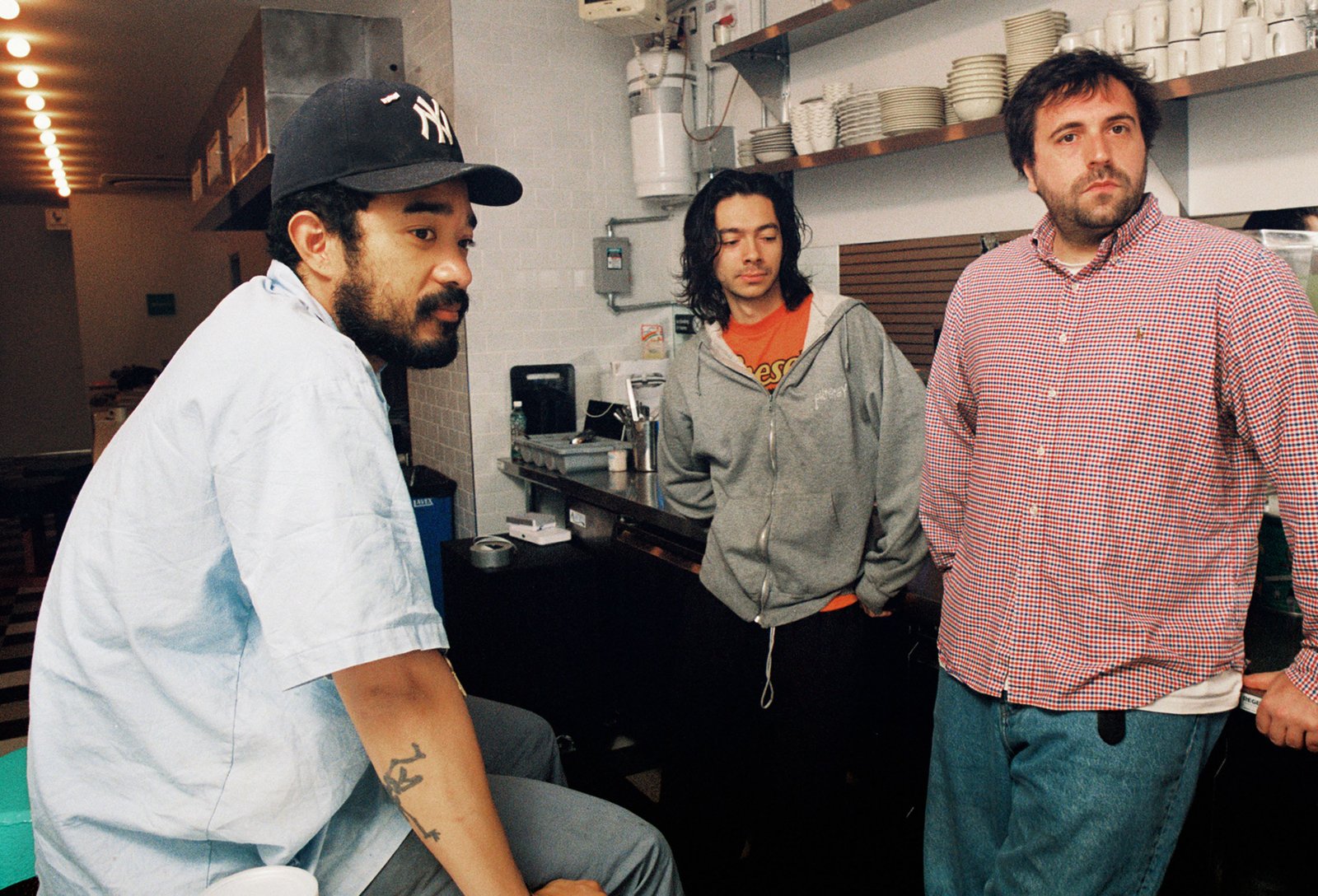
Lucien Smith (left) and chef Mathieu Canet (right) in the kitchen of FOOD—the multihyphenate’s answer to Carol Goodden and Gordon Matta-Clark’s iconic artist-run restaurant.
CG: How are you trying to make your FOOD different from the FOOD of the 1980s?
LS: I think it’s very much the same. That’s what’s cool about FOOD. It’s like, an apple today probably tastes a lot like the way an apple tasted in the 1970s.
CG: Are you a particularly nostalgic person?
LS: Maybe too much. I’ve tried to really change that. I’ve tried, if anything, to remind myself to be present, because I’m in a really beautiful place where I can create freely, be healthy, all of that. I’m not stuck in that chaotic tornado of my 20s. So nostalgia, for me, serves more as a painful thing than a pleasurable one at the moment, because it’s this fear of being reminded of all these mistakes, but also the beauty of not making them again.
I think an artist is constantly trying to rewrite reality[c]—to force a change or create a spectacle of themselves, or of their work. I don’t feel that stress anymore. I think a lot of it is because my art career was, in a way, this sort of humiliation ritual. I was forced, at the most vulnerable time in my life, to be so public, and for the people around me to see me go from high to low. So it’s been this freeing experience where I’m no longer afraid to be accepted or rejected or to lose, which has released me from that kind of perception. That’s maybe why I don’t make as much art anymore. Or, if I do, it’s something I’m doing for myself, rather than to impress or change the perception of me. I would say it’s been in the last year that I’ve felt free of that urge to make something that changes the way the world feels about me.
CG: Well, what’s the last thing you did make?
LS: I made this guitar that had a bunch of Chupa Chup lollipops taped to it. One of the works I had the most fun making were these guitar paintings for Half Gallery. I had this show during Hurricane Sandy called Good Vibrations, and it was all about how I was trying to draw this comparison between the Seattle grunge movement and the rise of Nirvana, and how I think he inspired a lot of teenagers to want to become musicians. I felt that, at the time, I was going through something similar with art, and it was a double-edged sword, because I was so happy to see other artists relating and wanting to be artists, but then it was also like a mockingbird sort of thing. Is it a mockingbird, or a mockingjay?
CG: I’m not sure. Mockingbird, I think.
LS: Whenever I hear those birds, they sound very aggressive. It’s like someone laughing at you. And I felt that way about the art scene at the time. I wanted to crawl away from it. But these were works on guitars, using the guitar as the canvas to create these different shapes and silhouettes. It’s interesting to me that the last thing I made is the first, or only, artwork that I really enjoyed making.
CG: It’s clear that you have an interest in working in other mediums. Your Instagram handle, @feareatsthesoil, is a reference to the Fassbinder film, Ali: Fear Eats the Soul. Is that a movie you identify with, or is it just that you enjoy it?
LS: I definitely identify with it. I think about that building she lives in, and all the people who live in it. I have felt that way about the world at times. [Editor’s Note: Emmi’s neighbors in the film heavily scrutinize, shun, and reject her when she marries a much younger Moroccan man, whom she meets at a bar and invites to move into her apartment.] Fear is something that we all have to live with. But allowing fear to make decisions for you can be very dangerous. So I made that my username as a sort of memento mori, to now allow that to control my life.
CG: There’s a great scene in that movie where Emmi invites all the women over, and they crowd around Ali in the living room, feeling up his muscles and gawking about his beauty, his hygiene, his youth. Broadly, it could be an allegory for, like, extraction, and a kind of fetishization that happens in the art world.
LS: Yeah, I know that scene. I don’t know if I’ve ever looked at it so directly. It’s definitely that theme of exploitation for me. I think that being an artist is a beautiful thing, but it can also be sort of taboo. Not to bring up masturbation again, but you know that trope where, if you masturbate as a kid, you’ll go blind? I kind of think the same thing about art. Like, if you jerk off your art too much, you’ll lose sight of the world around you. And I think that’s what was happening to me. It does very much feel like that guy in the room, and the art world is like, Look at him, he can paint! Look how young he is! You know? I don’t want to be the subject in that room. I don’t want to be anyone in that room.
CG: On the subject of film, you’ve made two shorts, and then acted in another. Is that the next Lucien Smith act? Exploring filmmaking?
LS: I guess it comes back to role-playing. There’s a possibility that I was always just role-playing as an artist, or that I’m only role-playing as a restaurateur. Maybe that’s what we do as humans or professionals—play roles. I’ve written a film that I really like, but I love where I’m at in my life, with this restaurant. I think I’m mature enough to say now that maybe I’ll make that movie, but maybe I won’t. Maybe it just lives as a script. I’m willing to accept where I am now and just enjoy it. I just want the restaurant to find its harmony. I want it to find a place where I can let go of it and have it form a life of its own. And I think that’s possible, with time.
This story appears in Justsmile Issue 7, available to order here.