Architects Of Liberation
Ahead of the summer exhibition, MoMA curator Martino Stierli shares some of the research that inspired a show on modernist architecture in West Africa.
This story appears in Justsmile Issue 8, Shaping What's Next.
Text Angel Harvey-Ideozu
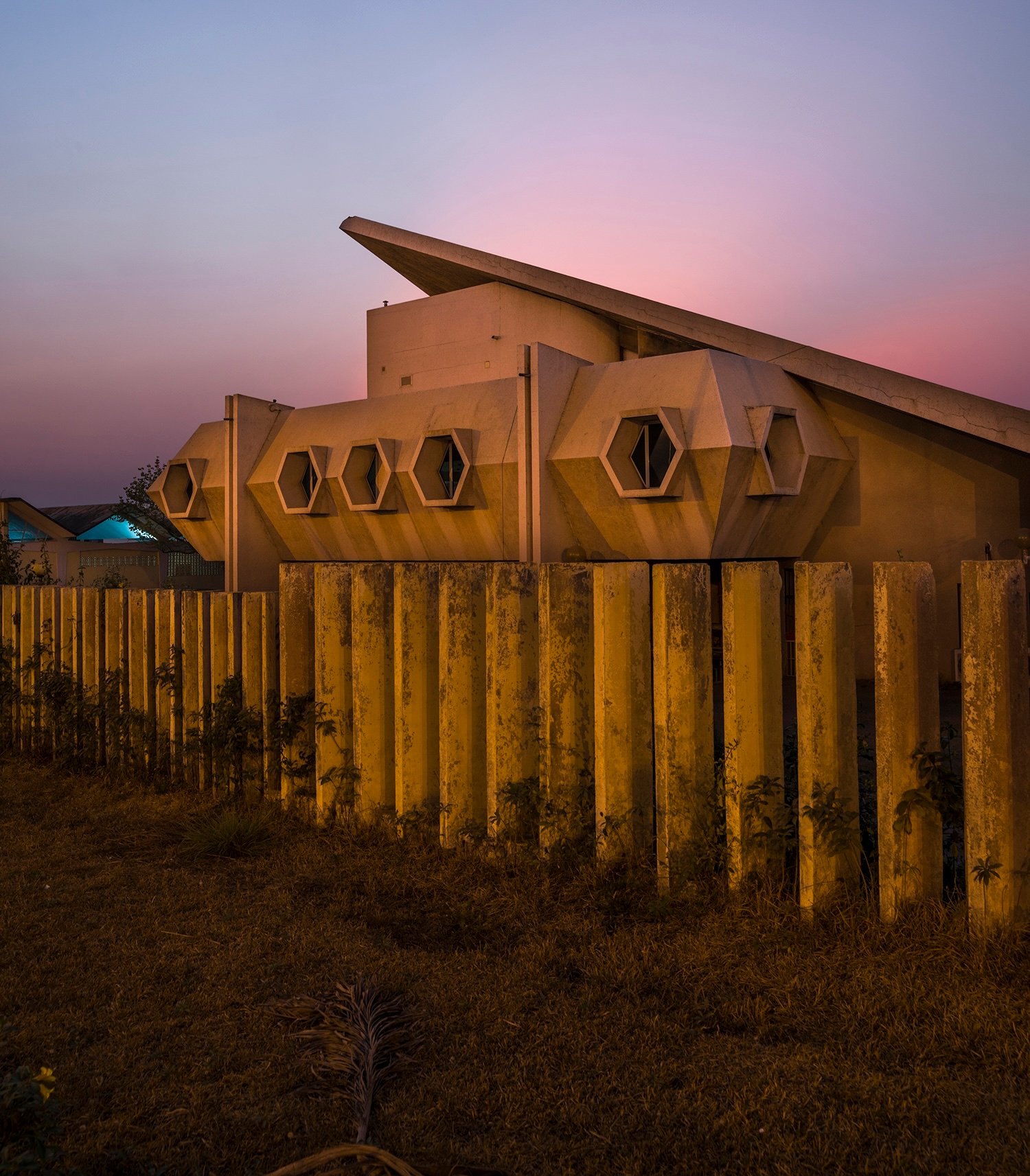
Lycée Mamie Adjoua auditorium, Yamoussoukro, Côte d’Ivoire. Completed c. 1978. Jean Léon (1937–2002). 2025. Photograph: François-Xavier Gbré
This July, Architects of Liberation: Modernism in Western Africa will open on the third-floor galleries of New York’s Museum of Modern Art. Organized by Martino Stierli, the Philip Johnson Chief Curator of architecture and design at MoMA, and Ikem Stanley Okoye, guest curator and associate professor at the University of Delaware, the exhibition is the first of its kind—surveying the structures that represent the region’s process of self-determination between the 1950s and ’80s, post-independence. Focused on seven countries—Benin, Cameroon, Côte d’Ivoire, Ghana, Nigeria, Senegal, and Togo—Architects of Liberation features objects, drawings, models, and photographs loaned from institutional and familial archives. Empirical and practical in its investigatory approach, which entailed—if not required—trips to the continent and literal recordings of first-person recountings, Stierli and Okoye (with MoMA’s Architecture and Design curatorial associate, Mallory Cohen) adjusted for the point, to the nature and context of place.
The third in a triptych of exhibitions, Architects of Liberation yanks the so-called Global South into the contemporary art conversation. Highlighting pioneering and imaginative world-making schemes such as the Centre International du Commerce Extérieur du Sénégal, with its triangular peaks rendered in primary color, stone, and mosaic, the show is a confrontation of big-A Architecture and institutions’ tendency to prioritize Eurocentric design.
With a background in architectural history and criticism, and a commitment to the polyphony of histories, Stierli has been plotting this three-point arc since his appointment to MoMA in 2015. Previously, he was a professor at the University of Zurich’s Institute of Art History, taught at Princeton and Columbia University, and served as a curator of international exhibitions like The Architecture of Hedonism: Three Villas in the Island of Capri at the 14th Venice Architecture Biennale. He’s also published a number of books, papers, and catalogs, including Montage and the Metropolis, which was shortlisted for the 2018 Book Prize of the Modernist Studies Association.
We connected a short while before the show opened, speaking on Africa’s place in 21st century design, and an optimism that breeds hope.
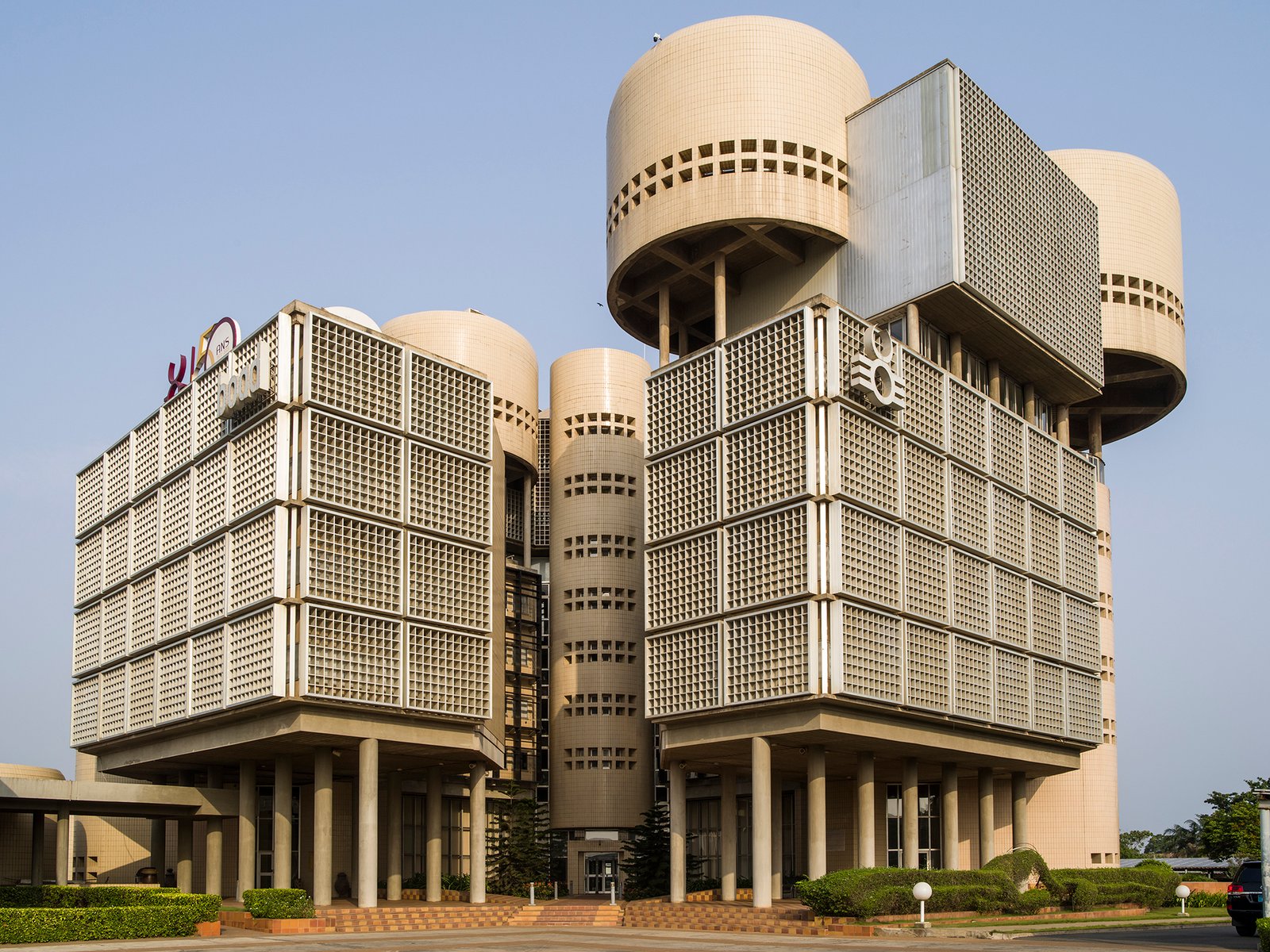
Banque Ouest Africaine de Développement (BOAD), Lomé, Togo. 1979–80. Guy Durand, Yves Ménard, and Messan Raphaël Ekoué-Hagbonon. 2025. Photograph: François-Xavier Gbré
Angel Harvey-Ideozu: Architects of Liberation follows the 2022 exhibition The Project of Independence, which looked at architecture and urban planning in post-independence South Asia. There’s a theme here around post-physical colonial occupation, which is ripe with potential for obvious reasons. Why does it resonate with you?
Martino Stierli: Architects of Liberation is actually the third in a trilogy of exhibitions. The first was Toward a Concrete Utopia: Architecture in Yugoslavia (2018), which looked at architecture at the end of the Second World War. Then came South Asia, and now West Africa. I conceived of this trilogy somewhat loosely at the beginning of my tenure at the museum in 2015. As an architectural historian, my initial impulse was to look at the institutional history of the representation of architecture at MoMA, which has had a very Eurocentric understanding of architecture [in the past]. All of the exhibitions had been about Western Europe, North America, and countries that were more geopolitically aligned with the West in the Cold War, such as Japan and Latin America—which the United States has always understood as its colonial backwater. Nowhere else ever got the representation.
Coming from academia, I knew that there was a lot of interest in challenging these canonical histories of modern architecture. And I wanted to bring that challenge to the institution of MoMA. I felt that a project about Yugoslavia, which was one of the founding members of the Non-Aligned Movement, conceived [in 1961] as an alternative in the bifurcated world order between capitalist West and communist East, would be a good starting point. Because the other Non-Aligned member states and founding nations were all in the so-called Global South: India, Ghana, Indonesia, and so forth. That was the starting point, but looking at the policies of the Non-Aligned Movement and the geopolitics that the countries within it led me more into post-colonial discourse, which then strongly informed the thesis of the three exhibitions. This started out as the project of an architectural historian who himself had worked on Western architectural history, and recognized that the world is much more complicated. Many stories that are relevant to our understanding of the modern world have just not been adequately addressed.
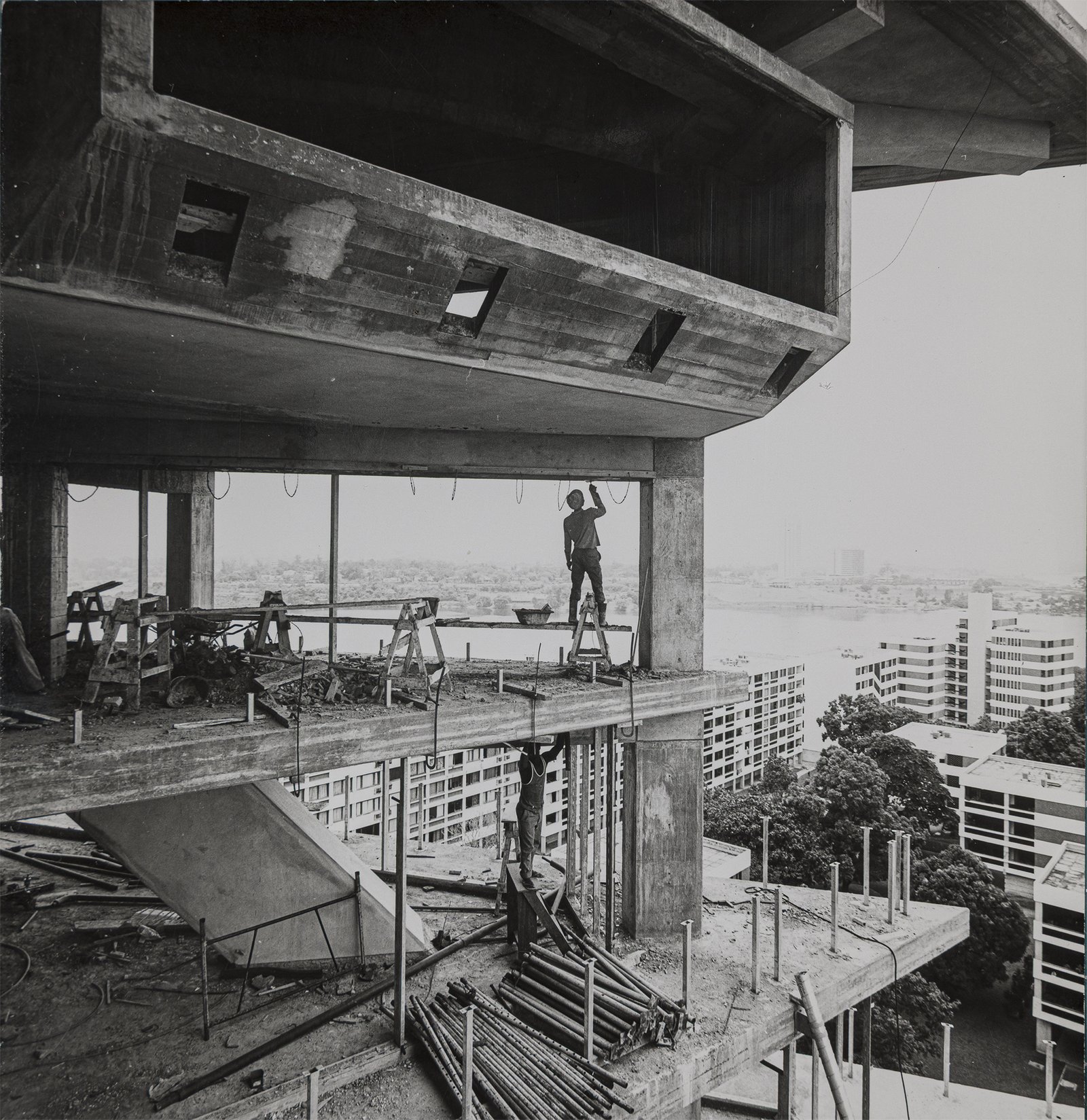
La Pyramide, Abidjan, Côte d’Ivoire. 1968–73. Rinaldo Olivieri (1931–1998). External view. c. 1973. Photograph: Rinaldo Olivieri. Rinaldo Olivieri Archives, Verona
AHI: What impact has that had on our understanding of architecture?
MS: I think the standard perception of modern architecture in a conservative worldview would have probably been an acknowledgement that modernism was a global presence—but with a clear value judgment that modernism was invented in Western Europe and spread across the “free world” before trickling down into the rest of the world. What more recent scholarship—including some of the work we’ve been doing at MoMA, I hope—has been trying to do is ask who was first. The myth of originality is irrelevant. Much more interesting is the question, How does a broad concept such as modernity perform in a specific sociocultural context? Innovation is the driving force of modernist history—the application of certain abstract ideas in very specific places and moments in time. These exhibitions argue that we have an incredible wealth of architectural innovation [outside of]Eurocentric modernism. Until quite recently, we haven’t been able to see that.
AHI: You started researching this exhibition four years ago, in 2022. Around then, other shows, publications, and institutions were focusing on West African art and design practices and histories, such as Nigerian Modernism at London’s Tate Modern and Tropical Modernism at the Victoria & Albert Museum. What do you think provoked this institutional interest in West Africa?
MS: That’s a really interesting question. Obviously, I can’t speak with confidence about what other institutions were doing, but I can answer for MoMA. On the lower arc of this trilogy, Africa [came third] because it was the most challenging and complex case. It’s probably evident that it’s easier to do an exhibition on Eastern European architecture than on West African architecture, considering the research apparatus that’s necessary, the distances to travel. I do think 2020 marked a moment of global reckoning with questions about race that institutions responded to, but that doesn’t necessarily explain why they looked to Africa. I can only surmise that the interest in the region’s history might have been because there is a recognition and awareness that West Africa is having a moment. It is one of the fastest-growing, most dynamic places on the planet, with incredible innovations across fashion and music—and that’s exciting. It really resonates with the idea of 1960 as the Year of Africa, where the entire world was also talking about Africa having a moment. The 20th century [was called] the Century of Africa, which never fully materialized. Now, again, there’s a general sense that Africa will have a much more prominent role around the world at the end of the 21st century.
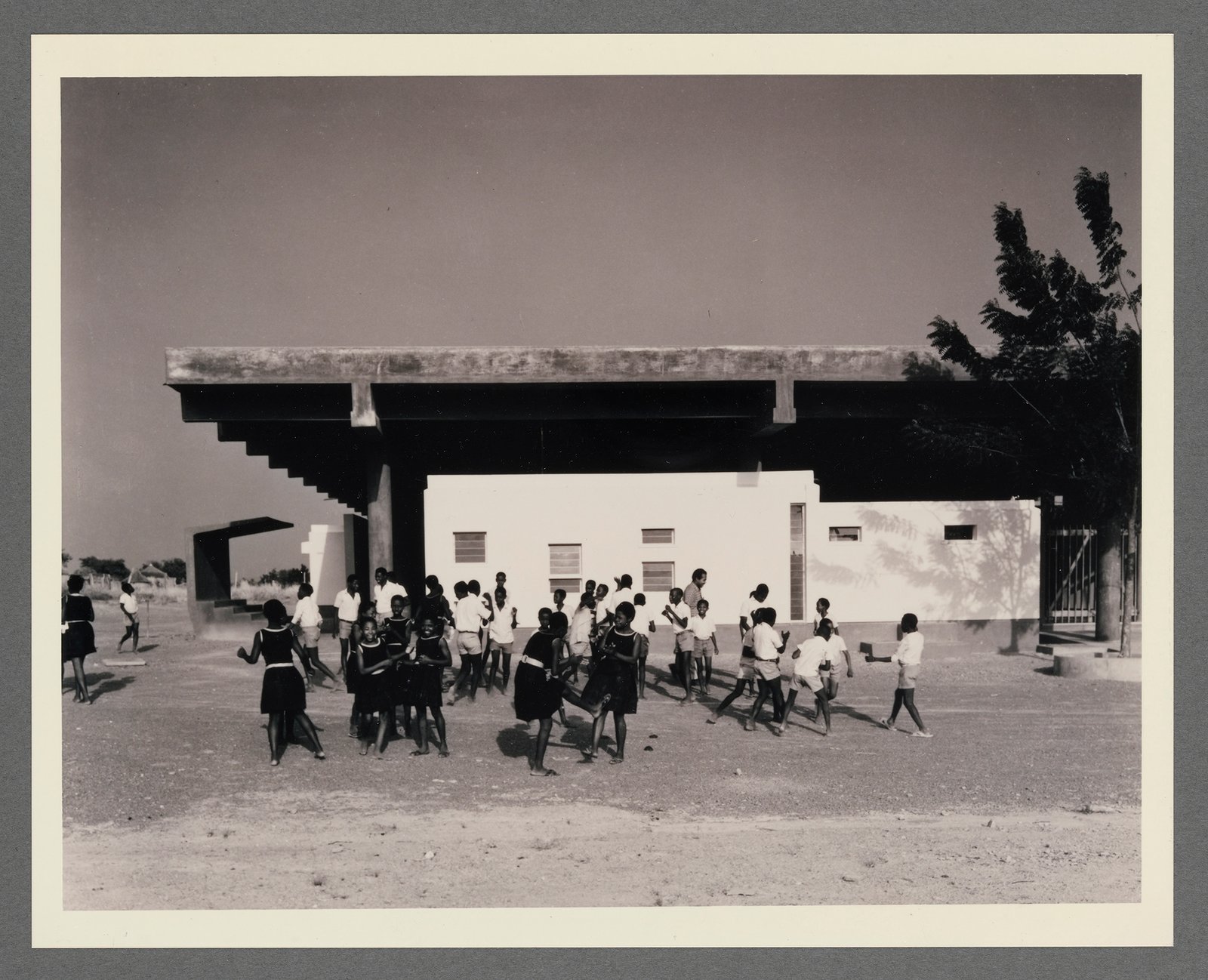
Children outside Bolgatanga Library, Ghana. December 1967. Photograph: Willis E. Bell. J. Max Bond Jr. papers, 1955–2009, Department of Drawings & Archives, Avery Architectural & Fine Arts Library, Columbia University. © Mmofra Foundation.
AHI: I imagine researching for this show was the most challenging, because of the extent to which Africa prioritizes oral tradition. Was that an obstacle?
MS: Not an obstacle, but a challenge! It meant finding the remaining architects who were still alive and recording their voices, or those of their families. And because architecture is, of course, much more than just the designer, it’s almost impossible to reconstruct this ecosystem entirely. At least part of our curatorial research project was a rescue operation to get on the record some of the voices that we were able to identify.
AHI: What were you reading and looking at during that period?
MS: Generally, we start research by acknowledging previous scholarship and putting together a bibliography of literature in the field. But very early on, it was about planning research trips to the places that we were interested in, connecting with people on the ground, and finding and hiring the main players to put us in touch with what they felt was interesting: the architects, the families, the archives. It was a very empirical approach.
There were a couple of titles I read that I want to mention, too. One was Okwui Enwezor’s The Short Century: Independence and Liberation Movements in Africa, 1945–1994. I did not see the exhibition, but I read the catalog, which is mainly about art but includes some architecture, thinking about how those decolonizing politics and modern art relate to each other. The other was African Modernism: The Architecture of Independence: Ghana, Senegal, Côte d’Ivoire, Kenya, Zambia—the exhibition that Manuel Herz put together [in 2015]. It created a sense of excitement that made me think, I must go see this. I want to bring this to the fore. I want to find the architects and the drawings. When you start historical research, you come across all of these amazing publications from around 1960 that really sparked a sense of excitement. I think you have to have excitement as a curator to engage with the subject matter.
AHI: Recently, I came across a tweet that spoke about Francis Kéré’s Startup Lions Campus in Turkana County, Kenya, referencing its natural systems for material, cooling, and ventilation. I’m increasingly seeing such posts, about nature- and history-conscious acts of modernity, and noting the excitement and positivity with which people embrace these ideas. It’s rather hopeful, isn’t it?
MS: I think it’s important to have hope. With an exhibition like ours, which deals with a very critical and problematic part of history, it’s important to show it was also a moment of great optimism and engagement with social, political, and environmental issues. It’s interesting that you mention Kéré, because what he really does is try to harness pre-existing material cultures and ways of building, bringing them into a contemporary conversation. Of course, Kéré is not part of our project because he’s of a much later generation, but what our exhibition will try to highlight is that this first generation of architects were also engaging with Indigenous knowledge and material culture in different ways.
AHI: What buildings, drawings, or models did you come across while researching that demonstrated the optimism of that first generation?
MS: There were so many. A number of trade fair complexes: in Dakar, CICES [the Centre International du Commerce Extérieur du Sénégal], the Ghana International Trade Fair in Accra, and the Lagos International Trade Fair. The Lagos and the Ghana campuses are like spaceships; they are so Afrofuturist. The Dakar fair is more grounded. What I find so fascinating about these buildings is that, while they have their differences, they were all able to capture the excitement of Pan-Africanism: the idea of bringing people together across randomly drawn colonial lines, in large buildings that almost operated as prompts for a politically and economically engaged society. They captured that Pan-African utopia, which was never fully realized.
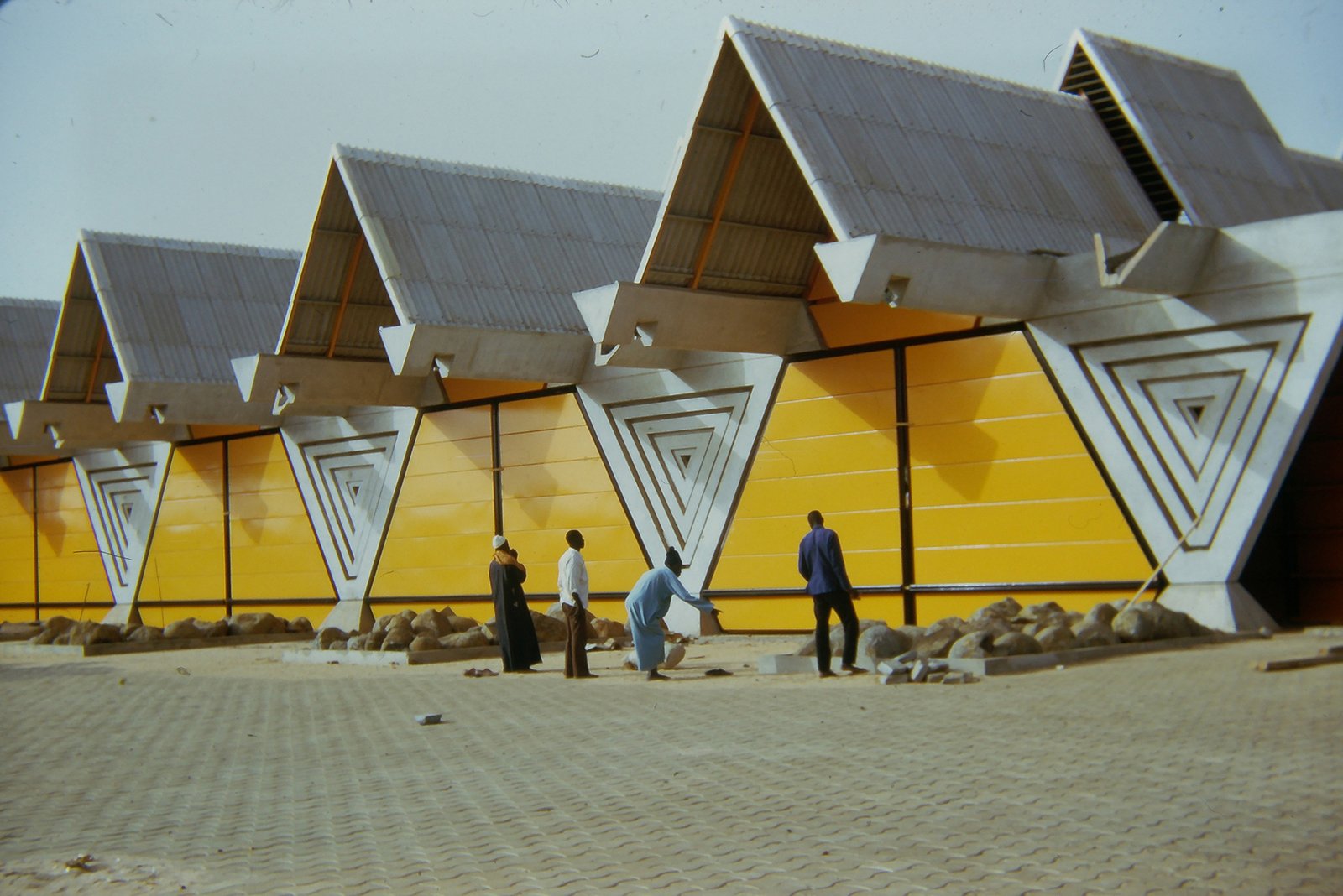
Centre International du Commerce Extérieur du Sénégal (CICES), Dakar, Senegal. 1971–74. Jean-François Lamoureux (b. 1943) and Jean Louis Marin (b. 1943). 1974. Photograph: Michel Fegyveres
Another building typology that really blew me away was the universities and higher-learning institutions founded in the post-independence period. This was a direct response to the fact that colonial powers [prevented] local populations from receiving higher education. I’m thinking of the polytechnic institutes in Yamoussoukro, Côte d’Ivoire], the University of Ife [now known as the Obafemi Awolowo University] in Nigeria. I was really moved by the fact that these campuses are not only still maintained impeccably; they’re also a source of great pride to the professors and the students, past and present.
AHI: When I was a kid in the early 2000s, I would visit the University of Ife, and even then, there was such a sense of pride amongst everyone there. That pride was always at the fore, growing up in Nigeria.
MS: Thank you for sharing that with me. It reminds me of a conversation I had years ago with Olalekan Jeyifous, the Nigerian-born, New York-based architect. I think that both of his parents were professors at Ife, and he basically grew up on the campus. He told me he was so impressed by the architecture that he became an architect.
AHI: After all this hope and joy and beauty, here’s a perhaps pessimistic question: Have these nations effectively adopted and reinvented once-colonial styles to create not just symbols of independence, but active pathways to self-determination and nation-building—up to the point of actual sovereignty? And if so, how?
MS: That’s a very complicated question. I think it was, and is, a process, and there are two sides to it: a sociological side and a formal architectural side. The sociological side of true sovereignty, first of all, [entailed] having a critical mass of native members of society who could lead these countries into self-assertion. And that was easier said than done, as there were no architecture schools in West Africa until after independence. Almost all the architects of the very first generation were foreign-born. But Ghana, for example, immediately founded an architecture school and mandated that on all major, state-funded projects—which was almost every project, because it was a socialist society—international senior architects would team up with Ghanaian junior architects. The idea being that they could learn on the job and lead on the next project. That system worked, although not as quickly as people wanted. It’s a process. The moment of political independence is a brief moment of respite in a long march still happening today. The younger generation of architects currently working in West Africa is the fruit of that moment. I think they see themselves in this larger historical trajectory, and that’s wonderful.
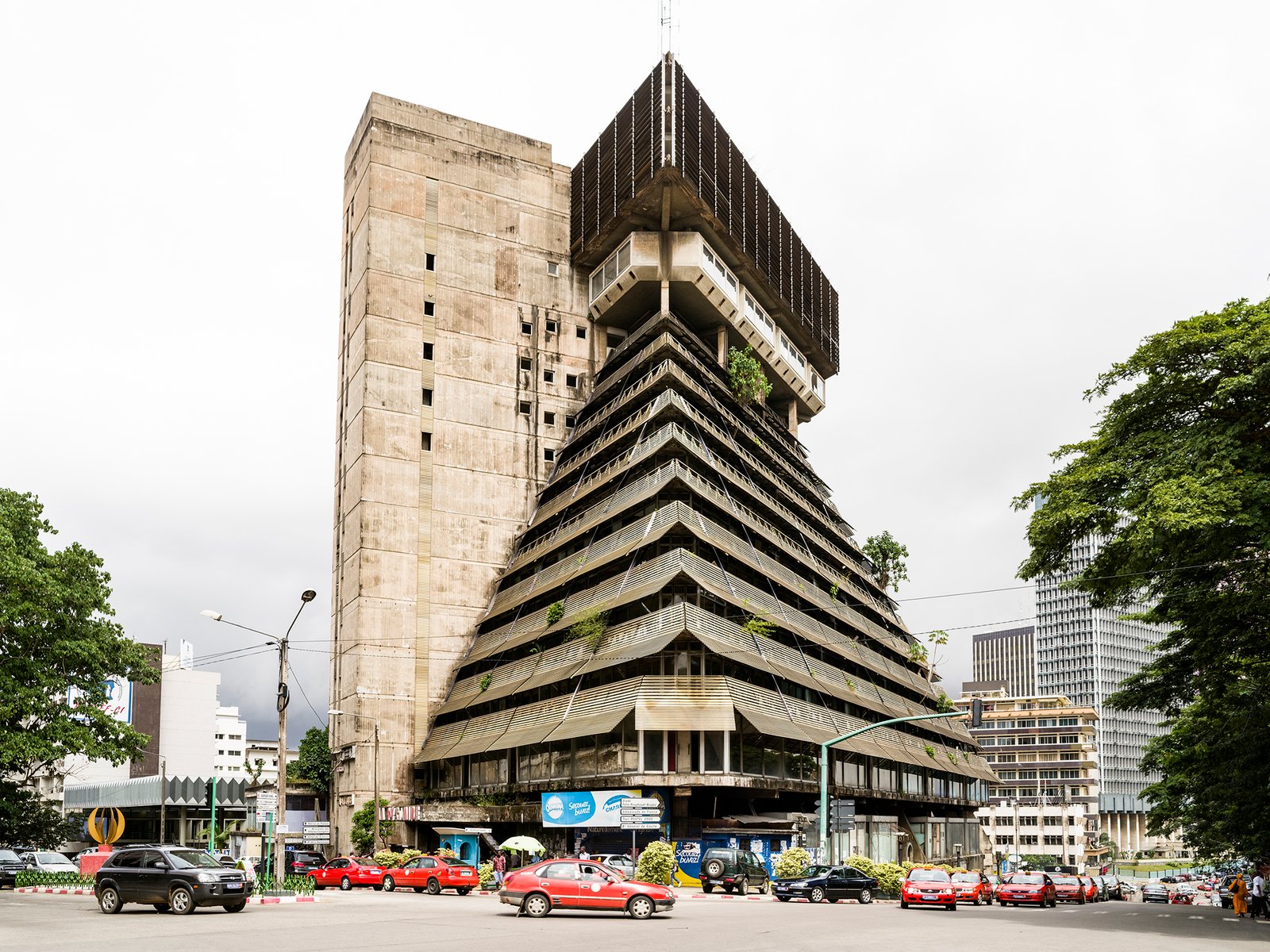
La Pyramide, Abidjan, Côte d’Ivoire. 1968–73. Rinaldo Olivieri (1931–1998). 2025. Photograph: François-Xavier Gbré
This story appears in Justsmile Issue 8, available to order here.