Kiyan Williams Revisits The Fissure
The multidisciplinary American artist talks flag frying, ancestral pilgrimage, and posing unanswerable questions to the Earth.
This story appears in Justsmile Issue 7, What We Carry Forward.
Photography Ashley McLean
Text Zoë Hopkins
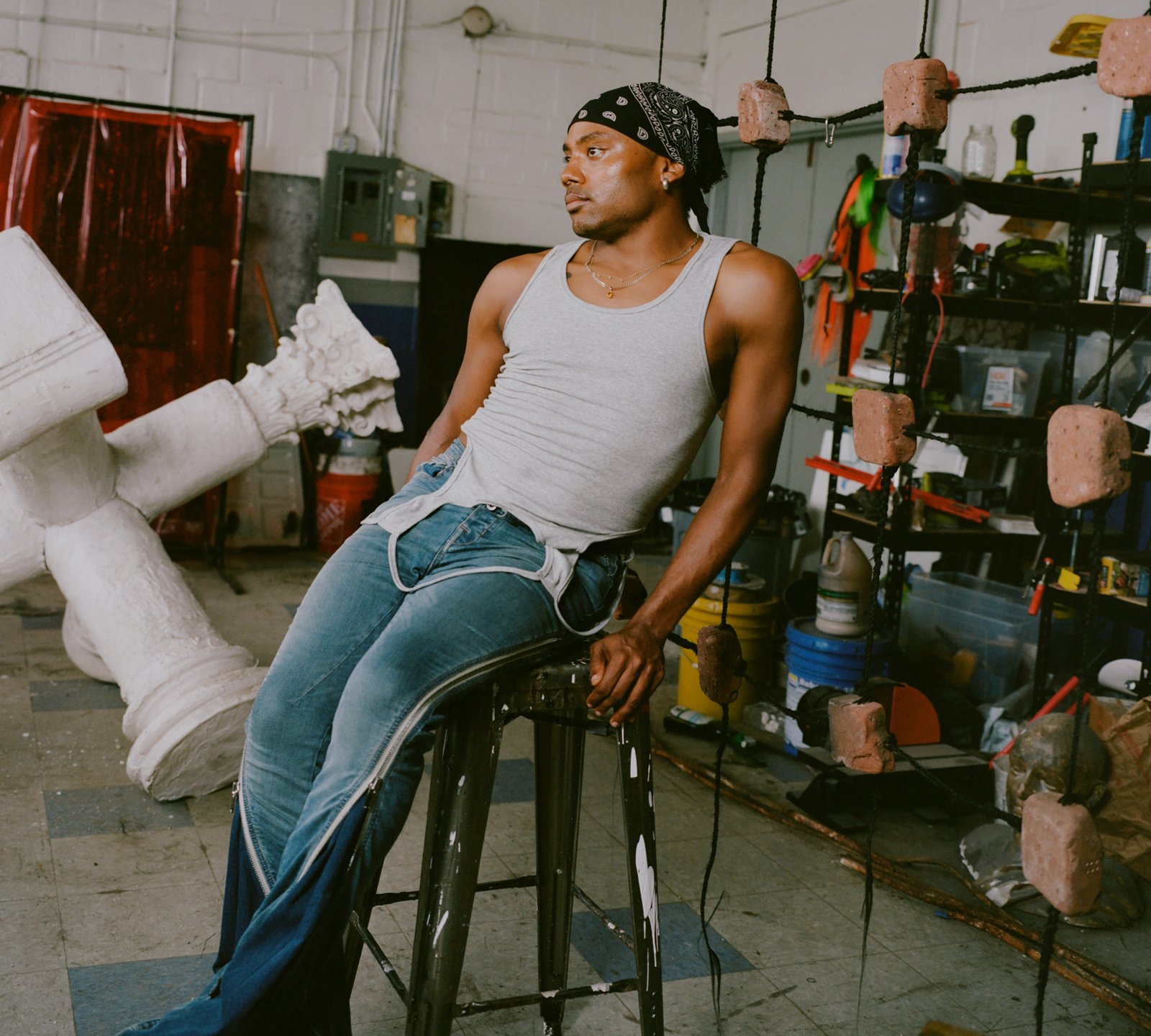
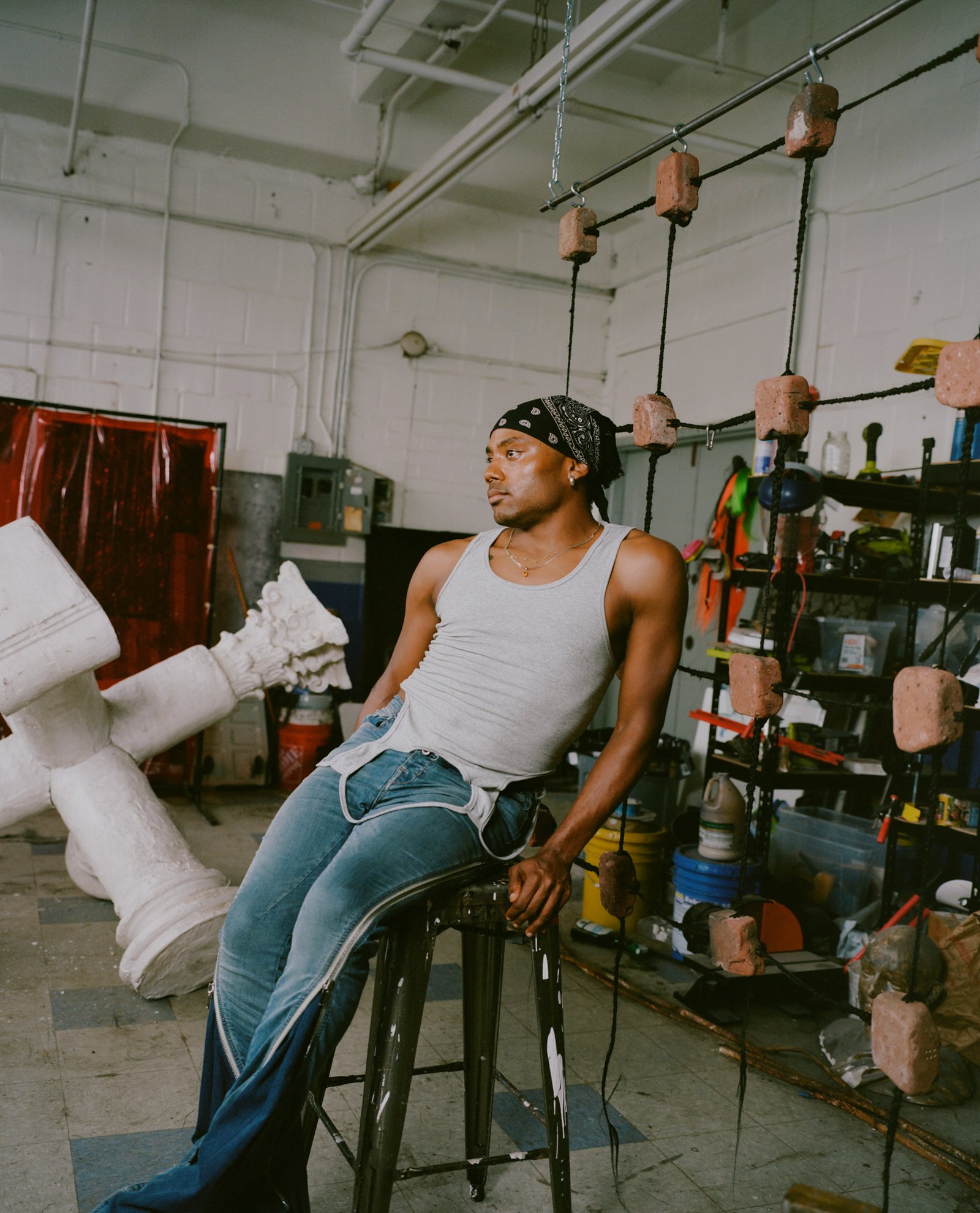
Williams in their studio in Brooklyn, New York.
Soil, sweat, and the debris of history accumulate and converge in the cracks and crevices which live in Kiyan Williams’s work. Based in Brooklyn, Williams gathers the stuff of the environment around them, employing it as found material. Their multidisciplinary, antidisciplinary practice, which involves sculpture, performance, installation, and video, tends to take all matters of the Earth—its soil, its rocks, the secrets buried therein—as its point of departure to overturn the ground on which hegemony rests, planting new seeds of life informed by Black and queer metaphysics and epistemology. Guided by the principle that the land holds immanent knowledges and intuitions, key to the survival of those who have been dispossessed from it, Williams digs for ways of knowing without invading the Earth’s right to occultism, with utter respect for the quiet tremors of all that it conceals.
In the interview below, Williams discusses the history of their practice—moving from An Accumulation of Things That Refuse to be Discarded (2019) to Ruins of Empire II or the Earth Swallows the Master’s House (2024). As the conversation unfolds, we devote particular attention to Williams’s recurring motifs, like alchemy, transgression, translation, attention to archives, and archaeology. The artist returns, time and time again, to what it means to ask the Earth questions you know might be unanswerable, imagining what small glories might be found in the crust of the unknown.
Zoë Hopkins: I always like starting by just orienting myself—physically, psychically, geographically—in the space that you’re in.
Kiyan Williams: I’m in Brooklyn, along the East River waterfront, where my studio has been for the last three years. It’s an old converted warehouse that holds the residue of its industrial past. The neighborhood still has the feeling of a place where things are made, and it remains an important site of entry and exit for maritime travel. Being able to look out onto the water feels energizing. These are elemental and geographic markers that ebb and flow into my own work. It’s a grounding place for my practice. It has recently become a site of inquiry, one of the many places I visit to collect materials for my work.
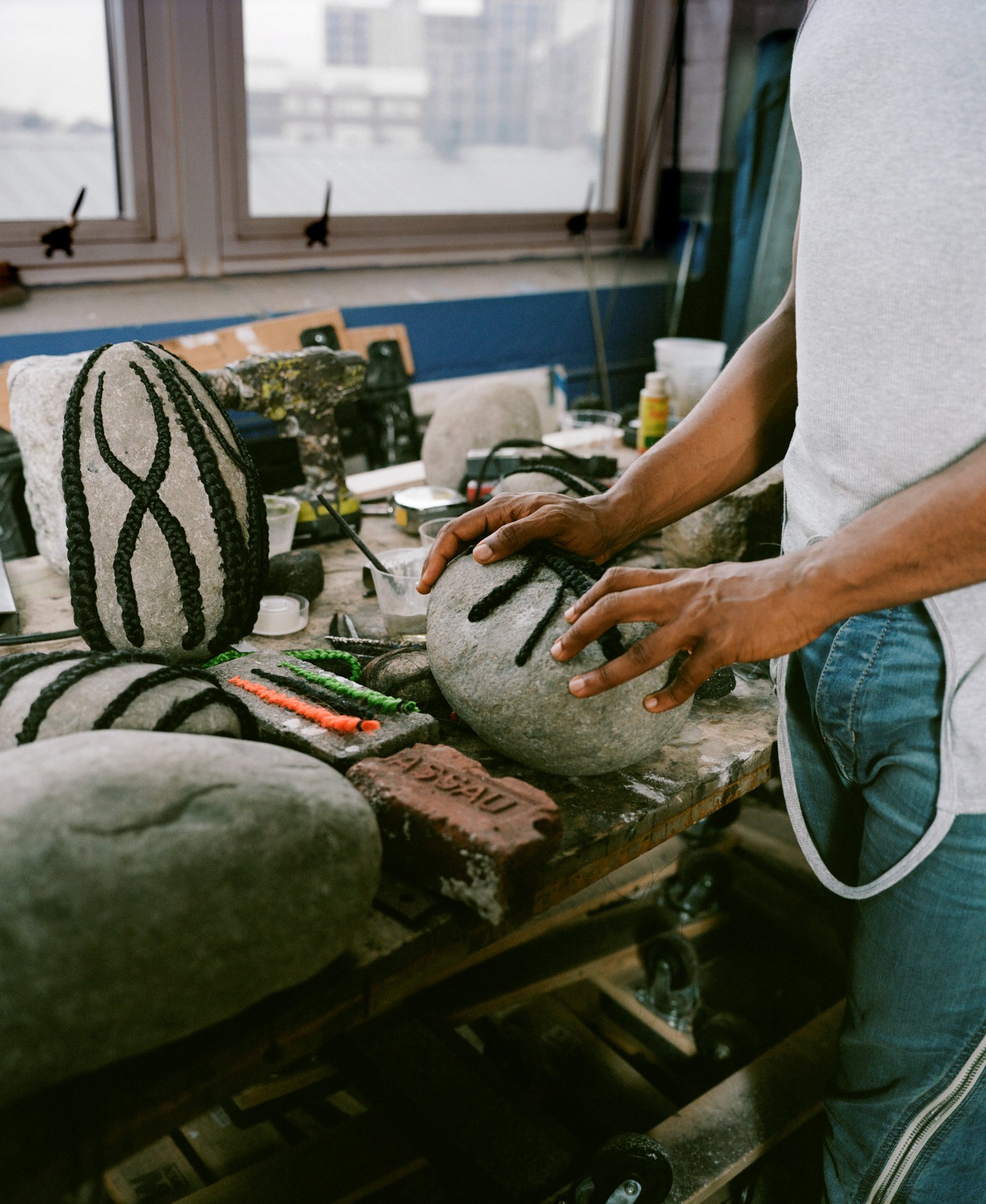
Williams works with found material—often, rocks, soil, and other organic traces of the environment they’re creating within.
ZH: I want to ask about the work you did a few years back, frying the American flag. Why was the deep fry a revelatory gesture for you? What kind of equivalencies do you locate between flag burning and flag frying? Did it ever occur to you to eat the flag?
KW: That work is part of a practice in which I’m appropriating American iconography. I was really interested in refusing the sense of ideological permanence embedded in symbols of Americana—playing with them, twisting them. I think a lot about this David Hammons quote, where he says that “magical things happen when you mess around with a symbol.” That project came from a desire to join an art historical practice of mostly American artists who took up and appropriated the flag as both symbol and material, from Jasper Johns to Danh Võ to Hammons to Cady Noland, and the list goes on. I wanted to engage this symbol through my own kind of creative means.
Part of my practice is really invested in rethinking quotidian materials, or what could constitute a sculptural practice. I very rarely buy materials from an art store. Most of the materials I use in my practice come from the world, and I’m translating and manipulating them to transform their familiar, material, and conceptual properties. The fried flag emerged from a time in my life where I was cooking a lot, sharing recipes with friends. One day I became really intrigued by these moments of transformation happening with the food, catalyzed by heat and other elements. I began to think of cooking, using heat and fire, as a process of abstracting surface. I was interested in the tension in how food is simultaneously grotesque and delectable, desirable. I wanted to apply that to the symbol of the flag, to see how I could transform and play with an object for which there are these strict protocols around how it’s physically engaged—like how you touch it, or don’t, for the most part. I wanted to literally put my hands on it and to transform it.
It was exciting to think about it in relation to what you said, about burning versus frying. When I coated the flag with batter and seasonings, it would come out of the oil with these layers that looked like skin. So then it appears malleable—fleshy and corporeal. It was exciting to transform this sterile, nationalistic object, imbued with such historical rigidity, into something vulnerable. The flag is partially legible in a way that feels undetermined or ambiguous. The proposition of making sculpture out of a flag is something I expanded into a live performance. The flag became a canvas that was transformed through this collective mark-making gesture.
‘I’ve always thought of the elements— the earth, the weather, the wind —as collaborators and protagonists in my work.’
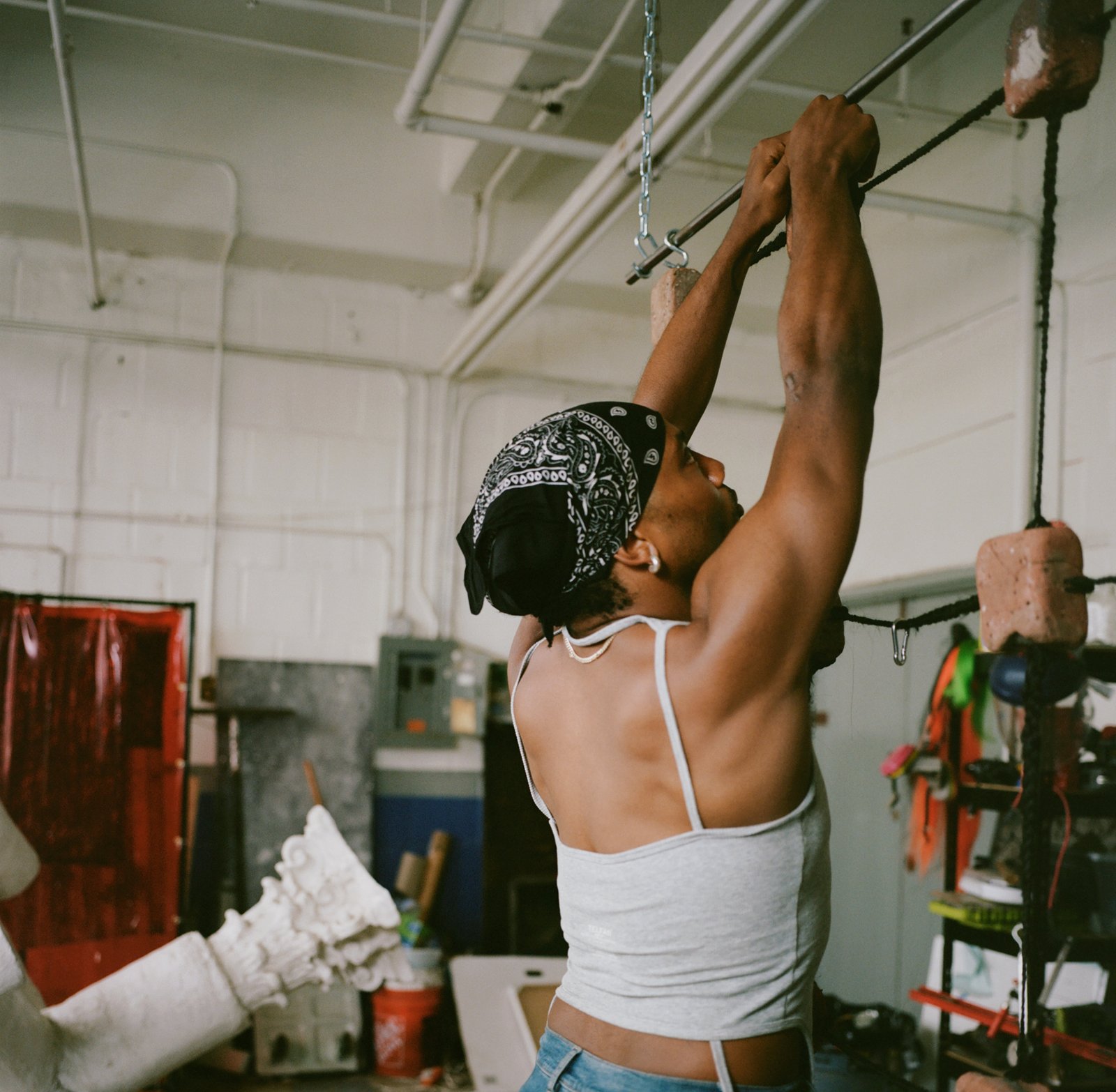
Williams in their studio in Brooklyn, New York.
ZH: One of the first works of yours that I encountered was at The Shed. It was a video in which you were picking up soil and throwing it at a wall—gradually, the soil formed something like the shape of the American continent. I was totally mesmerized by this serialized, reiterative gesture of throwing, hauling, abjecting organic matter onto what appeared to be a gallery wall, clean and aesthetically neutered. I guess I’m thinking of it as a coalescence of catharsis and control. Where in your body does the relationship between the self and the soil resonate first? And what does it mean to attend to soil as a material of the discarded, jettisoned, thrown out/away?
KW: Thank you for taking me back to that work. It was 2019. I was still in grad school, and that was the culmination of a lot of my thinking at the time. I was collecting bricks and earth and architectural debris from the construction site of a demolished building in West Harlem that wasn’t far from my first studio at Columbia. I was retracing the migration routes of my paternal ancestors, some of whom lived in those towering brick housing projects. One of the first addresses I arrived at on this ancestral journey was this demolished building. Later, I would braid those bricks into a suspended sort of aggregation, for this piece titled An Accumulation of Things That Refuse to be Discarded. Along that same journey, visiting what I would call sites of subjugation, I was consulting these census records and found the last address of my fifth-removed great-grandmother, who was from St. Croix, a small Caribbean island that was formerly a Danish colony.
I revisited that last address. I revisited both the plantations where they were enslaved, and the last addresses of my first ancestor, who was emancipated. Only the foundation of the house in St. Croix was intact, so it was this overgrown ruin of earth, wild plants, and concrete; the house had been demolished through neglect and hurricanes. So I started collecting the earth and remnants from those sites, and it became the matter I used in the piece at The Shed. For me, the point of contact or dissolution is always the site, and it’s a consistent throughline in my practice: returning to a place that speaks to histories of diasporic subjectivity, where there are no markers of the people who lived at these abandoned ruins.
I’m compelled by this attempt at recovery. It’s always an impossibility, but letting that be a source of energy fuels me to travel thousands of miles, searching for people or answers that won’t be found. I have to contend with the fact that there are certain things I cannot know. And so the architectural, the earthen matter I collect from these places, is residue imbued with historical resonance. But I still refuse cohesive or coherent narratives and resolutions, which is where the work happens. When I go back to the studio, I have to contend with that impossibility and move through it. That’s when my hands begin to work, and the alchemy takes place. I often think of the work that I’m making as embodying the materiality of loss. In the work you’ve mentioned, the earth accumulates onto the white wall and forms a rough outline of the continental US that then dries and cracks. For me, the fissures, the cracks, constitute a grammar of unbuilding, and a grammar of fragility.
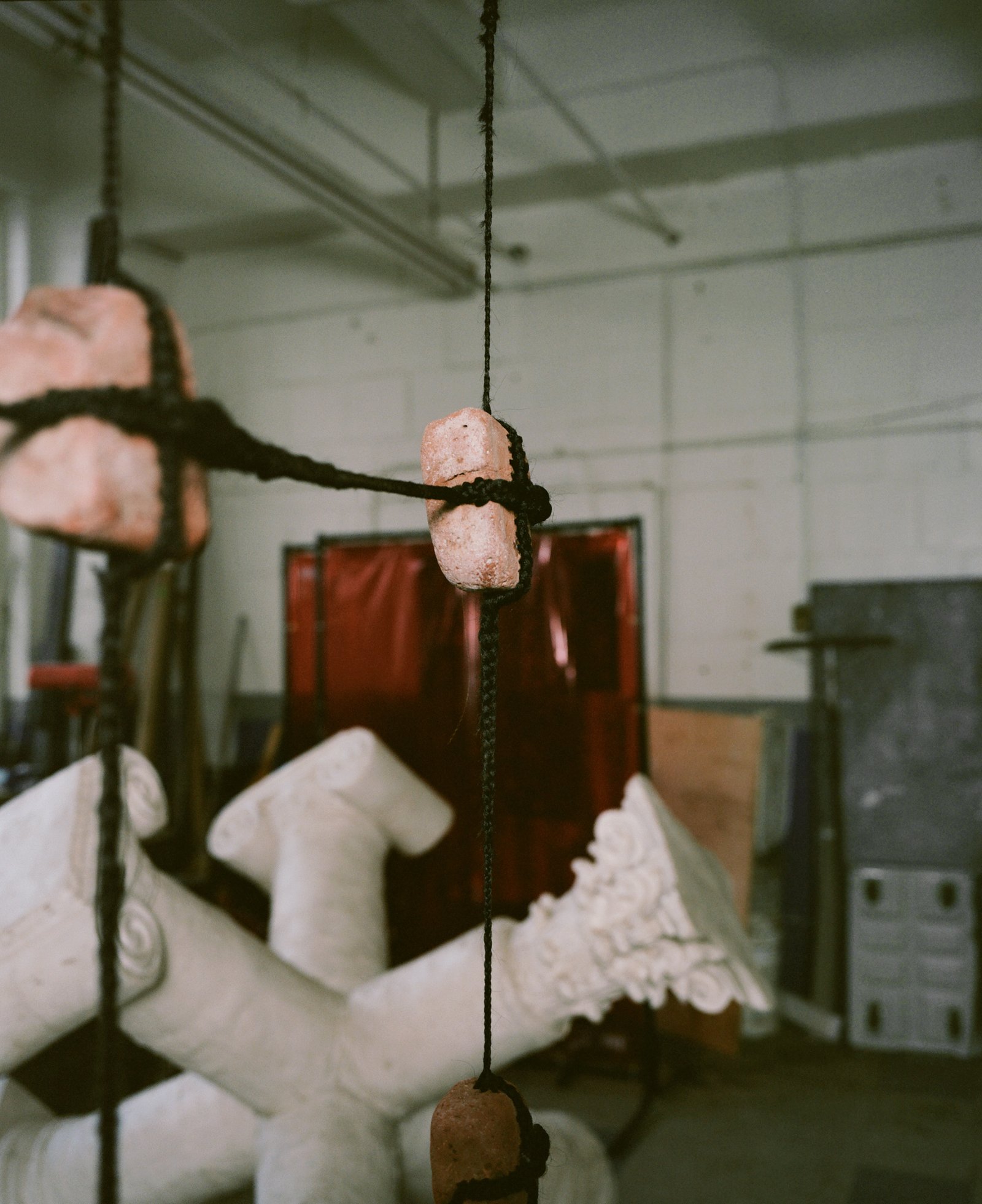
Bricks are a motif in Williams’s practice, marking their journey mapping sites otherwise erased from institutional archives.
ZH: What you’re describing is both a poiesis and an undoing, wherein unbuilding becomes the condition of possibility for knowledge. A knowledge production generated through movement with the unknown, or movement inside the fissures that the unknown makes in the foundation of the knowable. I’m curious how you think of the epistemic distinction between the kind of archaeological work you’re doing—which involves digging up the soil and searching for the unanswerable—versus archival work.
KW: I’ve been conducting archival research looking at historic photographs that document the construction of the nation’s capital, including the Capitol building and the White House. I tend to lead with archival research. In some ways, it always reaches a limit, because of the archive’s failure to represent, to hold, to document Black life or existence in the margins. There’s always a point when the limits of the archive reveal themselves—when people, for example, show up as property. From those failures, from that absence, I’m often compelled to look outside of what cannot be contained, held, or represented by an institution.
That archaeological research is a way of looking at what is outside of the literal page. Often, I’ll find some source of information that will guide me to my next step in the journey. An address, for example, catalyzes the journey of retracing my ancestry, a sort of pilgrimage to the places where my ancestors emerged from or arrived at. When I arrive at a new location, there’s so much information that can’t be represented on a page: the geography, how a body feels in relation to the Caribbean climate, the plants and flora that emerge and proliferate out of ruin. Even that migratory pattern of plants in some ways reveals information about diasporic subjectivity that can’t be found in the archives.
‘There’s always a point when the limits of the archive reveal themselves...’
ZH: Maybe one way to frame it is: If the archive and the limits therein speak a grammar that attests to the putative disposability of Black life, then the archaeology attunes us to the exorbitance of the earth—which always contains a glut of memory and unknowable knowledges that refuse to be discarded.
KW: Absolutely. And part of me has an impulse to trouble the idea of archaeology, too. The beautiful thing about being an artist and thinking of art-making as this multi- or transdisciplinary practice is that I get to play and move across boundaries without ever being beholden to the kind of prohibited, prescribed modes and epistemologies of knowledge-production intrinsic to being an archaeologist. It’s useful for me to pick up what’s productive and leave the colonial baggage where it is. And so, in some ways, I get to think of myself as a historian, asking similar questions that historians do—but I’m not beholden to traditional historiographies or methodologies that emerge from the Enlightenment and Euro-Western modes of inquiry and discovery.
ZH: I’m super curious about some of the words that have come up over the course of this conversation: translation, for instance, in relation to transdisciplinary and transgression.
KW: I want to start with transverse. It makes me want to meditate on the role of the artist, or what my role is as an artist in the contemporary world. I’m thinking of the prefix trans—to move across, to move through. In some ways, I think I’m moving across and through modes of knowledge or meaning, making and unmaking, simultaneously trying to bridge them together. I think there’s also a mode of transgression there: acts of not being, or transgressing various methodologies. I’m thinking about the act of making and unmaking as a way of unbuilding meaning. The fissures and cracks in the work are the visual language of unbuilding. And the process by which that happens is when I’m sculpting. The cracks emerge in response to the material doing what all matter does: transforming in different environmental and atmospheric conditions. The cracks emerge through evaporation, shifts in heat, moisture, temperature. I’ve always thought of the elements—the earth, the weather, the wind—as collaborators and protagonists in my work. With the flag, there’s this gesture of collective unmaking. But in the case of those earthworks, I’m thinking of them as being unbuilt in collaboration with the elemental—the natural world and gravity. And those sculptural gestures of fragility are co-constituted by my hand, in collaboration with natural forces. That collective endeavor constitutes how I think about the symbols and iconographies I’m appropriating being unmade.
I would say that the act of transgression in the context of art comes when an element is playing with the notion of single authorship, acknowledging agency among extra-human natural forces beyond my own hand. The work really becomes the work through relinquishing, when it’s morphed and weathered and transformed beyond my individual agency, desires, or impulses.
ZH: Have you ever made a work that’s been destroyed by its own materiality? For example, a sculpture made out of soil that’s disintegrated over time?
KW: I mean, earth is a super resilient building material. Across different cultural contexts and geographies, it’s used to make large-scale architectures that people inhabit. In some ways, with the transformation and dissolution that happens—and I’m talking specifically about my public art installations—there’s a kind of rewilding. Fugitive plantlife will abound and grow around [these works]. I have two sculptures up now at Art Omi in Upstate New York. They’re undergoing this process of expanding and contracting by heat, rain, and moisture. The earth is permeable. When it rains, there are shifts in the surface. I haven’t experienced a work dissolving, but what I have witnessed is the work being responsive and sensitive to touch. I almost want to say they feel alive, but I don’t want to unpack what sentience means. They don’t feel static. There’s a dynamism in the sculptures being responsive to the elements.
ZH: Which is totally another instantiation of collaboration in your work, namely between materiality and time.
KW: Totally. And to revisit the fissure—I’m thinking about my work at the Whitney [Ruins of Empire II or The Earth Swallows the Master’s House]—I think of it as a rupture through which other, perhaps illegible, ways of being or modes of knowledge emerge. The fissure as potentially a portal, a threshold, an index of permeability, or passageway. And I think all of these notions figure significantly into this larger project of making and unmaking meaning—that kind of totality the work circulates.
This story appears in Justsmile Issue 7, available to order here.